



Application and efficacy analysis of an FRG automatic quantitative soft packaging machine in packaging of isocyanate-modified polyurethane adhesives.
Nov 06, 2026
Isocyanate-modified polyurethane adhesives, as an important branch of high-performance adhesives, are prepared by reacting diisocyanates with polyester or polyether diols. This type of material combines the initial adhesion and flexibility of thermoplastic resins with the strength of thermosetting resins, and is widely used in the field of industrial bonding. However, its high viscosity and sensitivity to moisture impose strict technical requirements on the subsequent packaging process.
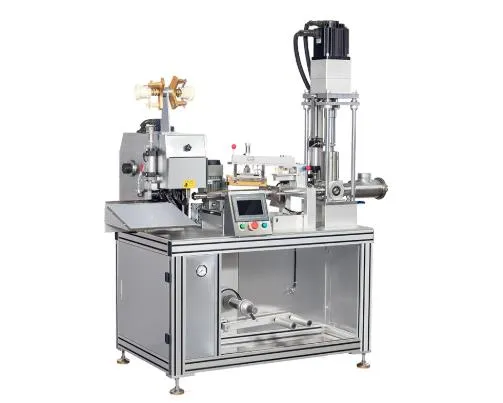
The FRG Automatic Quantitative Soft Packaging Machine has been specially designed to address the physical characteristics of this type of adhesive. Through hydraulically driven discharge, servo quantitative control, and fully automated integrated processes, it effectively solves industry pain points such as difficult packaging, inaccurate measurement, and poor sealing of high-viscosity materials, significantly improving production efficiency and product qualification rate. 1、 The packaging technology difficulties of isocyanate-modified polyurethane adhesive. According to materials science data, isocyanate-modified polyurethane adhesive has the following significant characteristics in production and application, which directly affect the selection and operation of packaging equipment:
The FRG Automatic Quantitative Soft Packaging Machine has been specially designed to address the physical characteristics of this type of adhesive. Through hydraulically driven discharge, servo quantitative control, and fully automated integrated processes, it effectively solves industry pain points such as difficult packaging, inaccurate measurement, and poor sealing of high-viscosity materials, significantly improving production efficiency and product qualification rate. 1、 The packaging technology difficulties of isocyanate-modified polyurethane adhesive. According to materials science data, isocyanate-modified polyurethane adhesive has the following significant characteristics in production and application, which directly affect the selection and operation of packaging equipment:
High viscosity and complex rheological properties. In order to improve heat resistance and adhesion to metals, polyester polyols with a relative molecular weight of 500~3000 are often used in the formula, especially poly (alkylene glycol adipate) with a hydroxyl content of (3.3 ± 0.2)%. These high molecular weight raw materials result in extremely high viscosity and poor fluidity of the adhesive system. During the packaging process, materials are difficult to rely on gravity and are prone to residue in pipelines and pump bodies, resulting in measurement fluctuations.
The isocyanate groups (- NCO) in the polyurethane molecular chain have high chemical activity and are highly susceptible to reacting with moisture in the air. If the barrier properties of the packaging material are poor or the sealing is not tight, it can cause the adhesive to deteriorate, swell the bag, or even fail. Therefore, the packaging process must ensure that the aluminum film is formed completely, the heat seal is tight, and there is no material carryover at the seal.
The accuracy of the two-component allocation ratio requires that this type of adhesive is often used in a two-component form and needs to be prepared in proportion before use. Both single-component bulk packaging and two-component matching packaging have extremely high requirements for measurement accuracy. Traditional mechanical or pneumatic filling methods often result in significant filling errors when dealing with high-viscosity materials due to unstable pressure.
FRG Automatic quantitative soft packaging machine is intelligent packaging equipment specially designed for high-viscosity adhesives such as sealant, structural adhesive, and foam adhesive. In response to the above difficulties, the equipment has undergone targeted optimization in terms of power system, control logic, and mechanical structure.
Hydraulic-driven discharge system: Solving the problem of high-viscosity conveying for isocyanate-modified polyurethane adhesives with high viscosity and poor flowability, the FRG Automatic quantitative soft packaging machine abandons traditional pneumatic or conventional mechanical extrusion methods; a hydraulic-driven discharge system has been adopted.
Stable and strong thrust: Hydraulic systems can provide stronger and more constant thrust than pneumatic systems. This stable high-pressure output ensures that high-viscosity materials can be quickly and evenly pushed into the filling head, avoiding flow interruption or splashing caused by pressure pulsation. Strong adaptability: The characteristics of the hydraulic system enable it to adapt to different batches and viscosity fluctuations of polyurethane rubber materials, ensuring the continuous and stable operation of the production line. Easy maintenance: Compared to complex pneumatic systems, hydraulic systems have a relatively simple structure and lower daily maintenance costs, making them suitable for high-intensity industrial production environments.
Servo quantitative control system: To ensure measurement accuracy and meet the strict requirements of two-component adhesives for proportioning accuracy, the FRG Automatic quantitative soft packaging machine uses a servo motor-driven quantitative cylinder for filling.
Digital precision control: The system precisely controls the piston stroke and motion speed of the servo motor through digital signals. Compared to extensive filling that relies on time or gravity control, servo control can achieve zero-level measurement accuracy. Flexible market response: Users can directly adjust filling parameters through the touch screen interface. When market demand changes and packaging specifications need to be adjusted (such as from 200ml to 500ml), there is no need to replace mechanical components, only setting them in the system greatly shortens the changeover time.
Fully automated integrated process: The FRG Automatic quantitative soft packaging machine integrates seven core processes of aluminum film forming, heat sealing, coding, quantitative filling, sealing (tail sealing), cutting, and unloading into one.
One person, multiple machines management: The highly automated process allows one operator to manage and monitor the entire production line. This significantly reduces the dependence of enterprises on labor and significantly improves per capita output efficiency. Eliminating human errors: Automated operations avoid fatigue, negligence, and other issues that may arise during manual operations, ensuring the consistency of appearance and internal quality stability of each bag of products.
Servo mechanical sealing system: Ensuring sealing reliability. In response to the high sealing requirements of polyurethane adhesives, the equipment adopts a mechanical sealing (or tail sealing) system controlled by servo motors.
The introduction of the FRG Automatic quantitative soft packaging machine has multiple practical benefits for isocyanate-modified polyurethane adhesive production enterprises: improved production efficiency, full process automation replaces tedious manual operations, and single-line production capacity is significantly increased. The rapid response of the hydraulic system shortens the single filling cycle time. Product quality uniformity: The combination of servo quantitative and hydraulic thrust eliminates the common phenomenon of "more in front and less in back" or weight deviation in high-viscosity materials.
The stable mechanical sealing ensures zero packaging leakage and reduces customer complaint rates. Cost structure optimization: Although the initial investment in equipment is relatively high, in the long run, the saved labor costs, reduced material waste (due to inaccurate measurement or leakage), and reduced rework rate will bring considerable investment returns to the enterprise. Wide adaptability of the process.
The stable mechanical sealing ensures zero packaging leakage and reduces customer complaint rates. Cost structure optimization: Although the initial investment in equipment is relatively high, in the long run, the saved labor costs, reduced material waste (due to inaccurate measurement or leakage), and reduced rework rate will bring considerable investment returns to the enterprise. Wide adaptability of the process.
Recent Posts


Contact US
Product Information
Quantity
Unit
Piece
Support order samples, customization, wholesale direct, and complete payment. If the product you look for does not have corresponding customized content, pls fill out the form below to contact us, and we will reply ASAP.