



FQLF Powerful Dispersing Machine: The Power Behind High-Quality Production of Urea Formaldehyde Resin Adhesive
Oct 23, 2026
In the artificial board industry, urea formaldehyde resin adhesive (UF resin) is a cornerstone. From the first synthesis of B. Tollens in 1844 to the development of an intermediate for room-temperature cured laminated wood by IG Company in 1929, this adhesive, which is made by the condensation of urea and formaldehyde, has become the main force in China's artificial board production due to its significant advantages such as simple manufacturing, low cost, rapid curing, and a colorless and non-polluting adhesive layer, accounting for more than 90% of the total usage. However, with the continuous improvement of environmental standards and physical performance requirements for artificial boards in the market, traditional production processes are facing severe challenges.
Especially in the production of modified urea formaldehyde resin with high viscosity and multi-component addition, how to ensure the perfect fusion of fillers and the resin matrix, how to eliminate bubbles to improve the compactness of the adhesive layer, and how to improve batch stability have become key bottlenecks restricting the production capacity and quality of enterprises.
The production of urea formaldehyde resin is not a simple mixing process. According to the data, in order to improve the shortcomings of urea formaldehyde resin such as poor water resistance, brittleness, and insufficient initial adhesion, it is usually necessary to add various modifiers and tackifiers such as melamine, phenolic resin, starch, polyvinyl acetate lotion, or polyvinyl alcohol in the production process. These additives have different physical forms - some are powders, some are high-viscosity lotions, and their compatibility with the urea-formaldehyde resin matrix is often poor.
In traditional mixing equipment, faced with such complex multiphase systems, the problem of "uneven mixing" often arises. Due to the significant increase in viscosity of urea formaldehyde resin in the later stage of reaction or after the addition of thickeners, ordinary stirring blades are difficult to reach the kettle wall and bottom, resulting in a large amount of raw materials adhering to dead corners, not only causing waste of raw materials, but also causing huge quality fluctuations between batches. In addition, air is easily drawn in during high-speed mixing, and if bubbles cannot be expelled in a timely manner, pores will appear in the cured adhesive layer, seriously affecting the bonding strength. What's even trickier is that the storage stability of urea formaldehyde resin is already poor (usually 2-6 months). If the shear heat generated during the mixing process is too high or the dispersion is uneven, it will further accelerate the aging and delamination of the resin, shortening its service life. Therefore, the market urgently needs an efficient mixing device that can provide strong shear dispersion, achieve no dead-angle scraping, and have a vacuum defoaming function.
In response to the pain points in the above-mentioned industries, the FQLF Powerful Dispersing Machine has become an ideal choice for urea formaldehyde resin production lines due to its excellent structural design and performance.
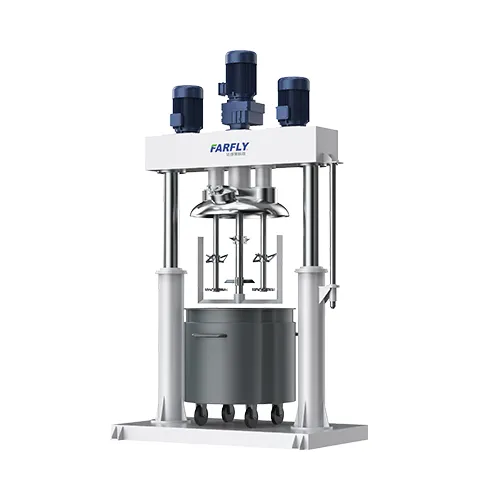
The core advantage of the FQLF Powerful Dispersing Machine lies in its unique transmission system. The equipment is equipped with three independent motors that drive three different agitators inside the kettle to perform complex planetary movements. Among them, a set of agitators revolves around the axis of the kettle body to ensure the overall flow of materials at a macroscopic level; The other two sets of agitators rotate at different speeds around their own axis at high speed. This combination of revolution and rotation causes the material to form an extremely complex motion trajectory inside the kettle, subjected to strong shear, rubbing, and dispersion effects.
For a urea-formaldehyde resin system with starch or polyvinyl alcohol added, this strong shear can quickly break up the agglomerated powder, tear the high-viscosity lotion into tiny droplets, and make it evenly embedded in the resin matrix. This not only significantly improves the utilization rate of the modifier, but also significantly enhances the initial adhesion and final bonding strength of the adhesive, solving the problems of low mixing efficiency and poor dispersion effect in traditional equipment.
When dealing with high-viscosity urea formaldehyde resin, the wall-hanging phenomenon is inevitable. The FQLF Powerful Dispersing Machine innovatively introduces a mountain-shaped scraper system. The scraper moves along its orbital trajectory and can tightly adhere to the kettle wall and bottom, automatically scraping off the adhered raw materials and rolling them into the central mixing zone.
This design completely eliminates the "dead corners" and "blind spots" in the mixing process. For the production of urea formaldehyde resin, this means that every drop of resin and every gram of filler can participate in the reaction and mixing, which not only improves the conversion rate of raw materials and reduces production costs, but more importantly, ensures the consistency of the entire kettle material. Whether used for bamboo wood splicing or manufacturing plywood, this highly uniform adhesive can provide more stable bonding quality and reduce the rate of defective products.
Urea formaldehyde resin is extremely sensitive to bubbles. The FQLF Powerful Dispersing Machine has excellent sealing performance and can be used in conjunction with vacuum systems. At the same time as strong dispersion, the equipment can operate in a negative pressure environment, effectively extracting bubbles generated inside the material and during the mixing process.
After defoaming, the density of urea formaldehyde resin is higher, and when applied to the surface of wood, it can form a more continuous and dense adhesive layer. This not only enhances the bonding strength, but also improves the appearance quality of the product. Especially in the production of high-end decorative panels or precision wooden products, a bubble-free adhesive layer is the key to ensuring product quality. In addition, the vacuum environment can, to some extent, suppress the volatilization of formaldehyde and improve the working environment of the workshop.
Considering the flexibility of urea formaldehyde resin production, the FQLF Powerful Dispersing Machine adopts a hydraulic lifting system, and the kettle body can move freely, greatly facilitating feeding, discharging, and equipment cleaning. For production lines that require frequent changes in formula or color, this design significantly reduces auxiliary time and improves production efficiency. At the same time, the equipment usually adopts variable frequency speed regulation, which can accurately adjust the stirring speed according to different stages of resin synthesis (such as the addition reaction period and the condensation reaction period) or different viscosity characteristics, to meet strict process requirements.
The FQLF Powerful Dispersing Machine perfectly meets the production needs of high-performance urea formaldehyde resin with its powerful shear dispersion ability, seamless scraping technology, and efficient vacuum defoaming performance. It not only solves the problems of difficult mixing, excessive residue, and bubbles in high-viscosity materials, but also helps enterprises reduce overall costs by improving production efficiency and product stability.


Recent Posts


Contact US
Product Information
Quantity
Unit
Piece
Support order samples, customization, wholesale direct, and complete payment. If the product you look for does not have corresponding customized content, pls fill out the form below to contact us, and we will reply ASAP.