



FRG Automatic Quantitative Soft Packaging Machine: A Solution for Efficient Packaging with Epoxy Resin Adhesive
Sep 30, 2026
In the field of adhesives, epoxy resin adhesives have long held a pivotal position due to their excellent overall performance. It is known as the "versatile adhesive" in the industry and is widely used in key industrial sectors such as aircraft manufacturing, automotive assembly, construction engineering, electronic appliances, and wood processing.
The reason why this adhesive has received such high praise is due to its unique chemical structure and physical properties: the abundant hydroxyl and ether bonds in the molecular chain endow it with extremely high adhesive strength, enabling it to produce strong adhesion to various materials such as metals, plastics, glass, wood, and even fibers; The curing process does not precipitate low molecular weight compounds, and with a dense benzene ring structure, the shrinkage rate is extremely low (can be reduced to 0.1%~0.2%), and the dimensional stability is excellent; At the same time, it also has excellent chemical corrosion resistance, good electrical insulation performance (breakdown voltage>35kV/mm), and a wide temperature range (-60~175 ℃). However, it is precisely these excellent performance indicators that impose extremely strict requirements on the packaging process in the later stages. How to maintain high purity and proportioning accuracy of epoxy resin adhesive while achieving efficient sealing and aesthetic appearance of flexible packaging in large-scale production has become a bottleneck that many adhesive companies urgently need to break through.
Epoxy resin adhesives are usually composed of two main components: resin matrix and curing agent. In order to improve performance, toughening agents, fillers, and other additives are often added. This multi-component characteristic, combined with partially modified epoxy adhesives (such as systems with added rubber or phenolic resin), often results in high viscosity and poor flowability. In traditional packaging operations, high-viscosity materials are prone to problems such as poor exhaust, large fluctuations in filling volume, and sealing and material clamping. Once the packaging is not tightly sealed, moisture in the air enters, or curing agent components leak, it can cause adhesive failure and result in huge economic losses. In addition, epoxy resin adhesive, as an industrial basic material, has a huge market demand and extremely high requirements for production efficiency. Manual operation is not only labor-intensive, but also makes it difficult to ensure the consistency of net content and sealing strength of each bag of products. In today's pursuit of precision manufacturing, manual operation is obviously unable to meet the needs of high-end customers.
Epoxy resin adhesives are usually composed of two main components: resin matrix and curing agent. In order to improve performance, toughening agents, fillers, and other additives are often added. This multi-component characteristic, combined with partially modified epoxy adhesives (such as systems with added rubber or phenolic resin), often results in high viscosity and poor flowability. In traditional packaging operations, high-viscosity materials are prone to problems such as poor exhaust, large fluctuations in filling volume, and sealing and material clamping. Once the packaging is not tightly sealed, moisture in the air enters, or curing agent components leak, it can cause adhesive failure and result in huge economic losses. In addition, epoxy resin adhesive, as an industrial basic material, has a huge market demand and extremely high requirements for production efficiency. Manual operation is not only labor-intensive, but also makes it difficult to ensure the consistency of net content and sealing strength of each bag of products. In today's pursuit of precision manufacturing, manual operation is obviously unable to meet the needs of high-end customers.
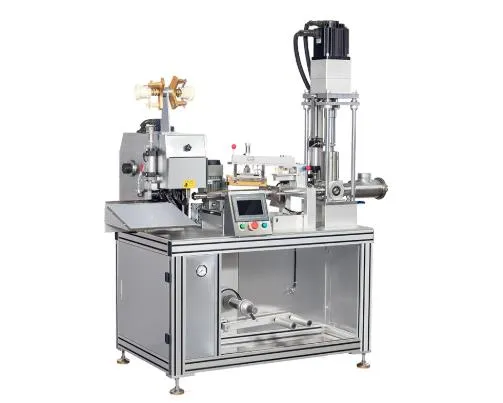
In response to these challenges, the FRG Automatic Quantitative Soft Packaging Machine has demonstrated strong professional adaptability. This equipment is not simply mechanical stacking, but deeply integrates international advanced packaging technology with the actual needs of the adhesive industry. Its most significant feature is the implementation of automated operations throughout the entire process. The equipment innovatively integrates the seven core processes of aluminum film forming, heat sealing, coding, quantitative filling, sealing (or tail sealing), cutting, and unloading into one, forming a complete automated packaging assembly line. This means that complex processes that used to require collaboration among multiple people can now be managed by just one person for the entire production line. This highly integrated design not only significantly improves per capita output efficiency, but more importantly, it completely eliminates quality fluctuations caused by differences in manual operation proficiency, ensuring that every bag of epoxy resin adhesive leaving the factory meets a unified high standard.
For the filling difficulties of epoxy resin adhesives, especially high-viscosity modified products, the FRG Automatic Quantitative Soft Packaging Machine adopts an advanced hydraulic-driven discharge system. Unlike traditional pneumatic or purely mechanical extrusion methods, hydraulic systems can provide stronger, more stable, and sustained thrust. This powerful thrust can overcome the internal friction resistance of high-viscosity materials, ensuring that the adhesive liquid quickly and evenly fills the packaging bag during the filling process, avoiding situations such as breakage, drawing, or insufficient filling. Meanwhile, the structure of the hydraulic system is relatively simple, making daily maintenance more convenient and effectively reducing the long-term operation and maintenance costs of the equipment. In terms of measurement accuracy, the equipment adopts a quantitative cylinder system driven by servo motors. By precisely controlling the stroke and speed of the piston through digital signals, high-precision quantitative filling has been achieved. Users can flexibly adjust parameters on the touch screen according to the needs of different product specifications. Whether it is small-scale trial production or large-scale continuous manufacturing, it can ensure extremely high measurement accuracy. This is directly related to cost control and reputation guarantee of adhesive products priced by weight for enterprises.
In addition to filling performance, the FRG Automatic Quantitative Soft Packaging Machine has also undergone extensive optimization in terms of packaging stability. The flexible packaging of epoxy resin adhesive usually needs to withstand certain transportation pressure and storage environment changes, so the firmness of the seal is crucial. This device adopts a servo motor-controlled mechanical punching/forming system, which runs more smoothly and responds faster compared to traditional mechanical cam or pneumatic punching methods. This precise mechanical structure can effectively avoid problems such as loose sealing, deformation, or loose clamping, ensuring that the flexible packaging remains absolutely sealed during subsequent transportation and use, preventing the adhesive from becoming ineffective due to moisture or leakage. In addition, the whole machine is based on a high-performance PLC controller as the core "brain", combined with high-precision servo motors and a touch screen human-machine interface, to build a stable intelligent control system. Each transmission component undergoes precision machining and strict quality control to ensure that the equipment can maintain extremely low failure rates and high repeatability accuracy even during high-speed operation.
In summary, the FRG Automatic quantitative soft packaging machine perfectly fits the production characteristics of epoxy resin adhesives with its full process automation, hydraulic-driven strong thrust, servo high-precision measurement, and stable mechanical molding system. It not only solves the industry pain points of difficult filling of high-viscosity materials, low manual efficiency, and poor packaging consistency, but also provides an efficient, accurate, and reliable packaging solution for adhesive enterprises through intelligent control methods. On the road to "universal adhesive" and moving towards broader application fields, the FRG Automatic Quantitative Soft Packaging Machine is helping enterprises enhance product competitiveness and promote adhesive packaging technology to a higher level with its outstanding performance.

Recent Posts



Contact US
Product Information
Quantity
Unit
Piece
Support order samples, customization, wholesale direct, and complete payment. If the product you look for does not have corresponding customized content, pls fill out the form below to contact us, and we will reply ASAP.