



FDT Concentric double-shaft agitator: production equipment for anaerobic adhesives
Aug 14, 2026
Anaerobic adhesive is a single-component, low-viscosity liquid adhesive that can be stored in a liquid state for extended periods in the presence of oxygen. When isolated from air, it can cure at room temperature into an insoluble and infusible solid. Anaerobic adhesives are widely used in the assembly and maintenance of machinery manufacturing, simplifying assembly processes, accelerating assembly speed, reducing mechanical weight, improving product quality, and enhancing mechanical reliability and sealing. Their main applications include thread locking, cylindrical part retention, structural bonding, impregnating micropores in castings, etc. Anaerobic adhesives are a type of industrial adhesive developed to address liquid and gas leaks in mechanical products, loosening of various threaded parts under vibration, and reform of mechanical assembly processes. They are closely related to the production efficiency, product quality, energy conservation, and environmental protection of the machinery industry.

The production of anaerobic adhesive liquid itself is relatively simple. It can be thickened and its strength adjusted by adding high polymers soluble in the adhesive liquid, to suit different usage scenarios and varying viscosity requirements. The use of surface treatment agents can significantly shorten the curing time, allowing the adherend to be positioned within minutes or even seconds, which is beneficial for use on automated assembly lines. The adhesive extruded from threads or outside the adhesive surface will not cure due to exposure to air and is easily removable.
The basic characteristics of anaerobic adhesives are relatively small volume shrinkage during curing, one-part liquid, room temperature curing, good heat resistance, impact resistance, and chemical resistance. Anaerobic adhesives are easy to use, can cure at room temperature, and the excess adhesive outside the glue line is easy to remove, resulting in an aesthetically pleasing bonded joint. They have good wettability to the adhered materials, require a small amount of adhesive per unit area, and their bonding strength is comparable to that of room-temperature-cured epoxy resin adhesives. After curing, anaerobic adhesives exhibit excellent resistance to heat, cold, acids, alkalis, salts, water, oils, alcohols, and other organic substances, as well as refrigerant media. They have strong adaptability and an adjustable performance range. Anaerobic adhesives are solvent-free, exhibit low curing shrinkage, and have high bonding strength to metals, making them highly reliable for fastening bolts. Anaerobic adhesives have a long shelf life and can be stored for at least one year or even longer at room temperature as long as they are properly packaged and stored.
Anaerobic adhesives also have some shortcomings. They are not easy to cure when the gap is too large. Generally, the allowable gap is 0.10~0.25mm, making them unsuitable for bonding loose or porous materials such as foam plastics. This is not only because anaerobic adhesives have low viscosity and are easily absorbed or lost, but more importantly, the oxygen contained in the above two states prevents them from curing. When bonding non-metals and the surfaces of certain inert metals such as stainless steel, zinc, and tin, surface promoters are required.
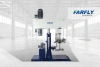
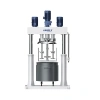
The FDT Concentric Double Shaft Mixer relies on five core advantages: concentric dual-shaft composite mixing, multi-size mixing component selection, heavy-duty stable base, kettle wall scraping to prevent material buildup, and easy disassembly and cleaning. It specifically addresses industry pain points such as poor powder dispersion in anaerobic adhesive production, material buildup on the walls, batch performance fluctuations, and residual bubbles. It stably produces anaerobic adhesive products with long storage periods and excellent sealing and locking performance, suitable for large-scale production of various specifications of anaerobic adhesives in the mechanical manufacturing field, such as thread locking, part holding, and casting impregnation. The low-speed scraper continuously scrapes the adhesive adhering to the kettle wall, while the high-speed dispersing disc cuts and breaks up polymer agglomerates, avoiding local deposition of high polymers and uneven component distribution, and reducing differences in viscosity and locking strength among different batches of anaerobic adhesives. It accommodates both pure low-viscosity basic anaerobic adhesives and thickened adhesive systems after adding a large amount of thickening polymers, capable of uniformly mixing liquid additives and completely dissolving solid thickening resins, meeting the production needs of anaerobic adhesives of different strengths and viscosities. With fast mixing homogenization speed, coupled with the pace of subsequent filling and application processes, it can stably supply the finished anaerobic adhesives required for automated assembly lines.


Recent Posts


Contact US
Product Information
Quantity
Unit
Piece
Support order samples, customization, wholesale direct, and complete payment. If the product you look for does not have corresponding customized content, pls fill out the form below to contact us, and we will reply ASAP.